Call 800-916-7873
Text your questions to 269-601-4965
Canada shipping is flat rate at $25.00 USD. All prices in USD
Air Quality Test in an office
Shipping is delayed about 2-3 weeks, but if you need a pad right away, just let us know in the special instructions during checkout and we'll get one to you as soon as possible at no additional charge.
Thank you for your patience as we continue to experience high demand for our products.
"New Dynamic Air Cleaner Supplies Clean room Quality Air"
Article reproduced from "Indoor Archives", Volume 4, Issue 1.
Sanit-Air Duct Cleaning and Air Testing
In our quest to find the best air cleaners for residential and commercial buildings, Sanit-Air has evaluated and tested the full gamut of devices, from ozone generators and ultra violet lights, to pleated media filters and electronic air cleaners. Factors incorporated into our evaluations include:
- Particulate removal efficiency
- Reduction in microorganisms
- Ease of retrofit
- Maintenance
- Customer satisfaction
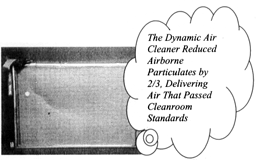
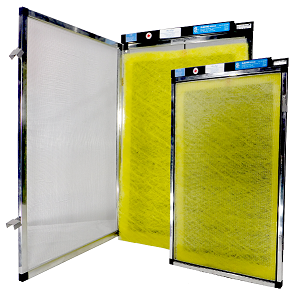
Initially, I was very skeptical of the Dynamic Air Cleaner. The one-inch, loosely woven media of the Dynamic was not very impressive looking. The manufacturer's representative pointed out the following advantages and principles of the Dynamic:
- The Dynamic Air Cleaner attaches a charge to dust. Charged dust will attract other dust particles that affix to the charged fibrous surfaces of the Dynamic.
- The electronic charge on the Dynamic is created on the interwoven fibers of the "pillow insert" that has a large surface area to which particles attach.
- The fibrous pillow is replaced every three to four months. No maintenance, other than brushing of the grid surface, is required.
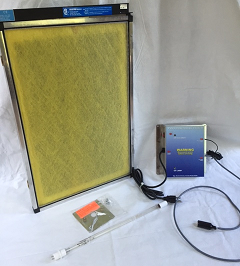
- An added bonus of the Dynamic Air Cleaner is the activated carbon insert that will remove odors and chemicals.
- The Dynamic Air Cleaner provides a 97% capture efficiency to particles down to .3 microns.
The scientist in me knew that only HEPA (high efficiency particulate arrestance) filters could trap particles at .3 microns and that true HEPA filters could not be installed in residential HVAC systems. The key difference in the Dynamic Air Cleaner is that particles are not trapped due to pore size, but are removed by charge. My skepticism waned as we received positive feedback from customers and good results in our microbial testing. However the true test came when I was hired to conduct particle testing for FDA compliance in a pharmaceutical clean room. Prior to testing the clean room, I tried out the new testing equipment in our office. The concentration of particles (.3 microns and larger) was less than 200,000 particles/ft/ this level was 3 times lower than the initial concentration found four months earlier. Equally surprising was the concentration of less than 70,000 particles/ft for .5 micron and larger particles. Our office passed criteria for clean room compliance - quite surprising since the clean room I tested had failed.
$12.50 FLAT RATE SHIPPING for the entire order!
800-916-7873
|
Click on the motorcycle to see why we are in business |
 |
All information on this site is intended for informational and educational purposes. All trademarks and registered trademarks, whether or not identified, are acknowledged to be the property of their respective owners.

©2024 All rights reserved